
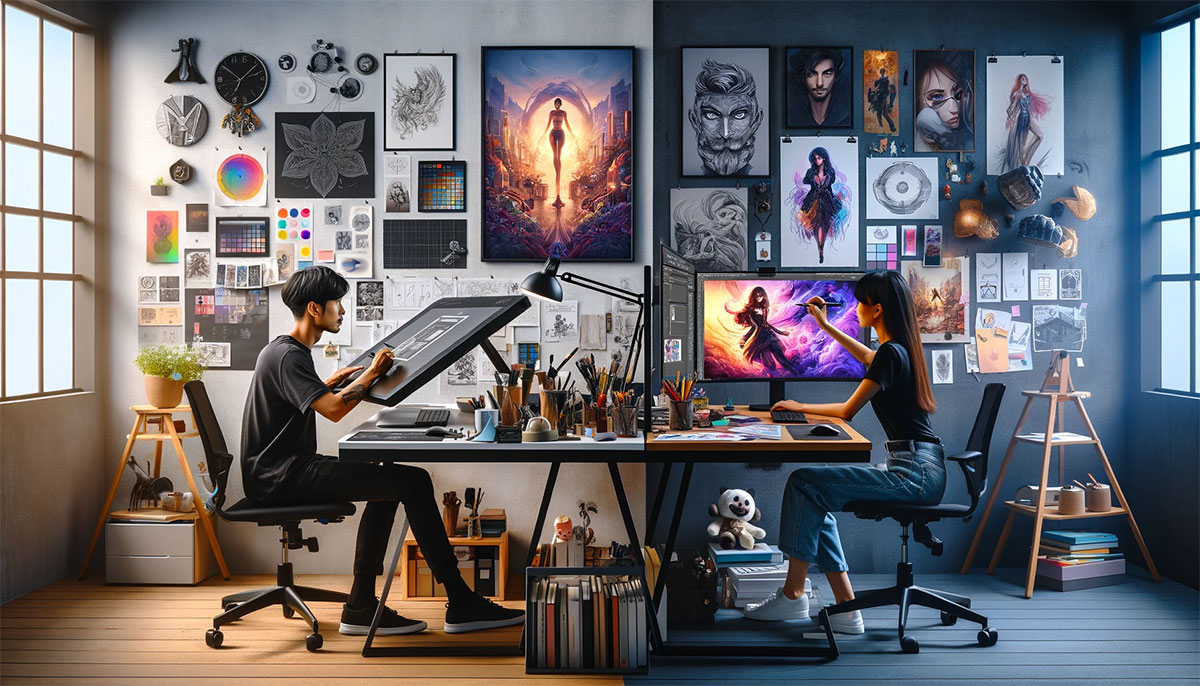
Old Scissors, New Code: A Real Talk on Traditional vs. Digital Pattern Making in Fashion
Let’s face it—fashion designers today live at the crossroads of heritage and innovation. On one hand, there’s something deeply poetic about the rustle of kraft paper, the crisp snip of shears, and the measured strokes of a pencil gliding across a muslin mock-up. On the other hand, there’s the seductive hum of a MacBook rendering patterns in seconds, scaling sizes with a few clicks, and letting you share your designs with a team halfway across the world. Welcome to the great pattern making face-off: Traditional vs. Digital.
A Love Letter to Traditional Pattern Making
If you’ve ever studied fashion in a hands-on atelier—or even binge-watched a season of Project Runway—you know there’s a romance to traditional pattern making. It’s tactile, intimate. You drape a muslin on a dress form, coaxing shape and silhouette from flat fabric. Your hands become the tools. The process is slow, yes, but it’s personal.
Legendary couturiers like Cristóbal Balenciaga and Madeleine Vionnet weren’t punching keys—they were sculpting fabric, literally. And there’s a reason their work still echoes on runways today. Traditional pattern making teaches you how a garment breathes, bends, and misbehaves on the body. It builds muscle memory, an instinctive understanding of grainlines and gussets that no software can replicate.
But—and here’s the kicker—it’s laborious. One change in your base pattern? Redraw it. Need a new size? Trace and cut again. Misplace a pattern piece? Back to square one. In a world moving at TikTok speed, this is where the method shows its age.
Enter Digital Pattern Making: Fast Fashion’s Tech Cousin (But More Ethical, We Promise)
Digital pattern making software like CLO 3D, Gerber AccuMark, and Optitex has completely disrupted the studio workflow—and not in a bad way. These tools allow designers to build, modify, and simulate garments in a virtual space. Need to grade sizes for an entire collection? Done. Want to preview how a bias-cut satin gown falls before you’ve wasted a single yard of fabric? Easy.
Take Elena, a young designer in New York who told me she cut her production time in half after switching to digital pattern making. “I used to spend hours adjusting shoulder seams on paper,” she laughed. “Now I tweak them digitally and see the drape instantly on a 3D avatar. It’s a game-changer for independent designers like me who don’t have the budget for sample after sample.”
Let’s not forget sustainability. With virtual sampling, you’re not burning through fabric or filling landfills with proto-garments. In an industry scrambling to green its footprint, that’s a serious win.
But Hold On—Is It All Binary Code and Roses?
Not quite. Digital pattern making, for all its sleek appeal, isn’t without friction. First, the learning curve. Mastering CLO or Gerber isn’t a weekend project. You need time, patience, and probably a few YouTube tutorials (or a full-on course). Then there’s the tech itself—glitches, licensing fees, system requirements.
And—perhaps most importantly—designers risk becoming a bit too removed from the physicality of clothing. No software can teach you how a fabric feels in your hand, how it responds to gravity. That sixth sense? It’s built in the sewing room, not the virtual lab.
So, What’s the Verdict?
Here’s the truth: it’s not either/or—it’s both/and.
Traditional pattern making grounds you. It sharpens your instincts and connects you to the craft. Digital pattern making elevates you. It makes you faster, more agile, and better prepared for the realities of 21st-century fashion production.
The most compelling designers of today—think Iris van Herpen, Marine Serre, or The Fabricant’s digital-only collections—are fluent in both dialects. They understand the story a seam tells on paper and how it translates into a pixel-perfect prototype. They embrace the slow dance of drafting and the slick tempo of tech.
Final Stitch
Whether you’re a student pinning darts into calico or a digital native sketching silhouettes in Blender, the future of fashion doesn’t belong to one method—it belongs to those who know how to use both with purpose. Pattern making, at its core, is about bringing ideas to life. And in a world with room for both scissors and software, the smartest thing you can do is keep both on your toolkit belt.
Now, tell me—are you team paper, team pixels, or a hybrid genius in the making?
🧵 Traditional vs. Digital Pattern Making: A Side-by-Side Comparison
| Feature/Factor | Traditional Pattern Making | Digital Pattern Making Software |
| Tools | Kraft paper, rulers, muslin, pencils, scissors | Computer, software (e.g., CLO 3D, Gerber), stylus or mouse |
| Learning Curve | Intuitive with practice; hands-on | Steep initially; requires software training |
| Speed | Slower; manual redrafting and grading | Much faster; instant modifications and multi-size grading |
| Flexibility | Limited; requires physical space and materials | High; designs can be easily modified and shared digitally |
| Sustainability | More material waste; multiple samples | Eco-friendly; enables virtual sampling |
| Tactile Feedback | Strong; direct interaction with fabric | Minimal; fabric behavior is simulated |
| Cost (Long-Term) | Lower upfront, higher over time (materials, storage) | Higher upfront (software, hardware), but scalable savings |
| Creative Flow | Organic and instinctual | Precise, with potential for fast iterations |
| Ideal For | Couture, bespoke, educational foundations | Mass production, remote teams, sustainable fashion startups |
🧵 Voices from the Studio: Designer Testimonials
Elena Rivera, NYC-based Independent Designer
“I used to love the ritual of pinning patterns and hand-drawing notches. But once I went digital with CLO 3D, I could scale and share my designs in minutes. It’s like adding a production assistant to my laptop.”
Malik Adani, Senior Pattern Maker at a Heritage Fashion House
“We still draft by hand for bespoke clients. There’s a soul to it. But for runway prep? Digital pattern making is our secret weapon—it keeps us agile in the chaos of fashion week deadlines.”
Chiara Fujimoto, Sustainable Fashion Entrepreneur
“Digital pattern making helped me reduce my sampling waste by 80%. I still drape occasionally for inspiration, but tech lets me stay true to my brand values—and budget.”